
Recently at a senior executive team retreat, one member of the team questioned the necessity of the two-day off-site gathering. The executive rationalized that: “We are a group of department heads paid to run our own shows. If I’m honest I’m not sure why I need to be part of a senior team, other than for occasional coordination. We’re all busy people with our own goals to achieve.” This is a common phenomenon: Members of the executive team are not quite sure why the team exists beyond coordination.
So, then how do you bring greater depth and direction to the conversations happening within your senior team? How can team members feel that they have a shared purpose and set of priorities? The Senior Team Priority-Setting Matrix was designed to help team members distinguish between goals they can pursue individually and goals they won’t be able to achieve unless they work together. The matrix has two dimensions, each of which can be seen as a continuum from low to high:
Dimension One- Stakes: How high are the stakes associated with this goal (e.g., financial, reputational, etc.)?
Dimension Two- Interdependence: What is the degree of cross-functional or cross-leader interdependence associated with this goal? 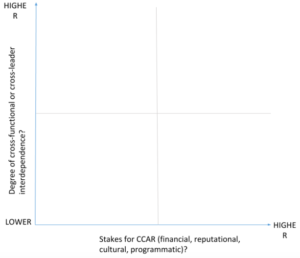
Using the above dimensions, ask your team members to plot their priorities on a chart. Notice which goals wind up in the upper right quadrant – high interdependence and high stakes. Goals in this quadrant should be the focus of senior team meetings. If there are no goals in this quadrant it is worth exploring what the team might be missing. For example, you can ask: are we neglecting our responsibility to align the way we incentivize and manage performance with our core values?
What are examples of goals that your senior team should have in its upper-right priorities quadrant?
Photo Credit: Josu.Orbe